
Field Notes No. 01: The Season of the Apprentice
It's mysterious being human. I think archaeologists spend much of their lives tuned into that mystery.
There is an alchemy embedded in this field. The work asks us to slow down, to observe carefully, to accept that not every question has an answer. I find myself drawn not only to archaeology as a discipline, but to the way it shapes perception. Thinking like an archaeologist has become a way of understanding myself and remaining open to the possibility that there is always more beneath the surface. I'm fascinated by ancient civilizations, unexplained structures, and histories that continue to resist certainty.
Recently someone asked me, “Why not just become an archaeologist?”
In many ways, I think I already am.
At its core, archaeology is the study of material culture. While I may not fit the traditional image of someone in the field, I feel exactly where I'm supposed to be, somewhere balancing between archaeology and the art world. My paintings have become another way of excavating, researching, preserving, and interpreting what it means to be human.
This summer has been filled with research, observation, and study, but what has surprised me most is how physical this learning has become. Rather than reading alone, I've spent time observing archaeology students at work while also apprenticing at a fine art framing and restoration workshop. Both experiences have deepened my sensitivity to craftsmanship.
Already, I can feel the apprenticeship changing how I paint. I'm more aware of the materiality of my work. I notice how my hands hold a pencil, how a brush moves across a surface, how every material carries its own history and responsibility. I'm curious to discover what other shifts this attention will bring into the studio.
My time observing students and faculty at Indiana University Indianapolis came at the perfect moment as I prepare for my next solo exhibition, Praxis, opening at the Cultural Arts Gallery on campus in September 2026.
Dr. Jeremy Wilson, professor in the Department of Sociology and Anthropology, generously invited me to spend a day in the university's anthropology lab. We had first met during a trailer screening for the Greenlawn Project at the Eiteljorg Museum. Dr. Wilson leads students and faculty as they examine and rearticulate the human remains recovered from that excavation.
Hidden away in a quiet basement laboratory, I watched students patiently clean bones, preserving every speck of dust. Brushes, measuring tools, bags, and archival boxes were arranged with remarkable care. In another room, beginning archaeology students studied anatomical models, learning to identify bones before handling real human remains.
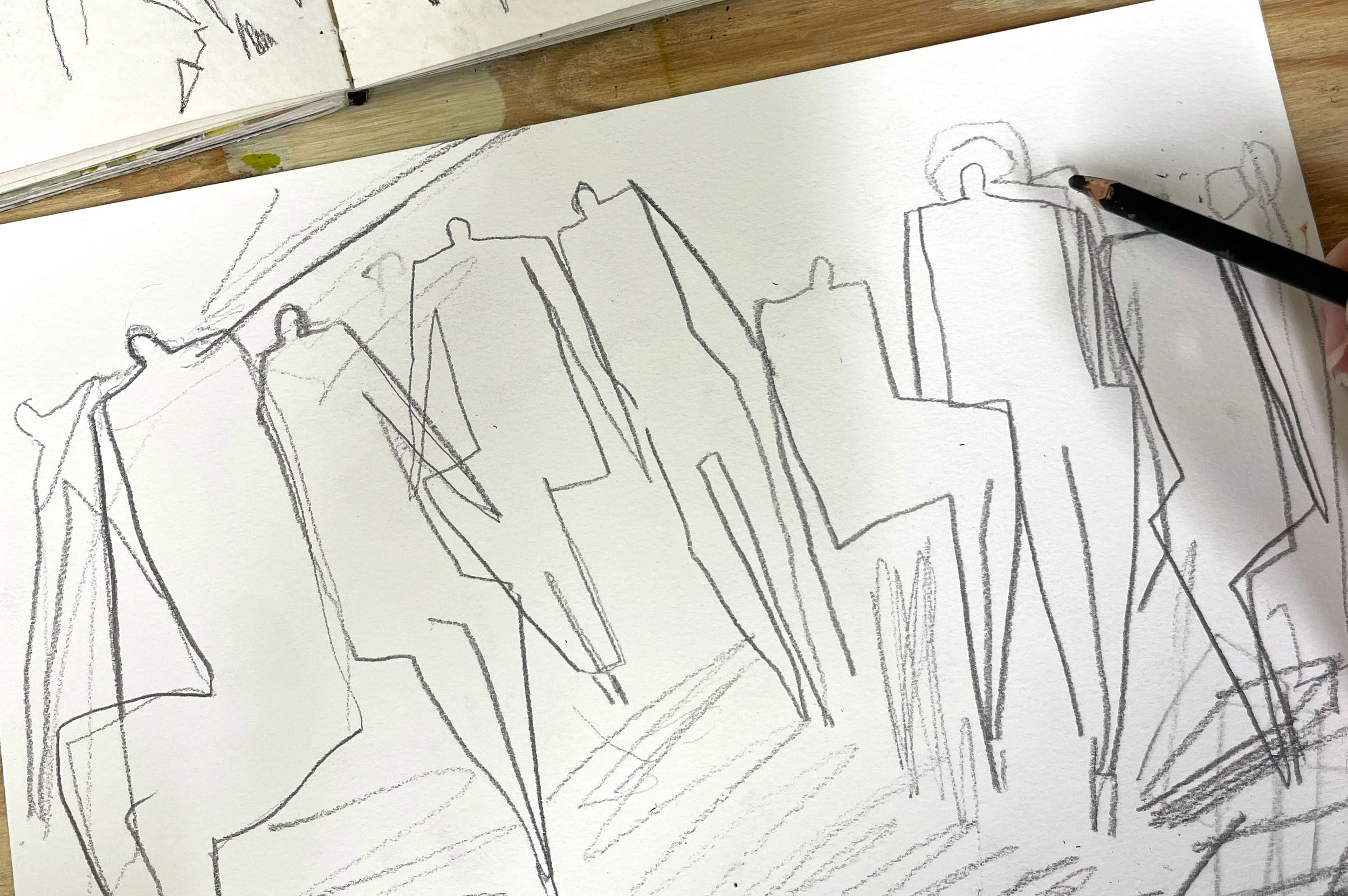
As I observed, I filled pages with sketches and notes. Yellow ochre. Burnt umber. Sepia. The colors of bone itself. I studied porous surfaces, tiny speckles, worn edges, and subtle indentations that quietly carried the stories of individual lives. An amputated wrist. Evidence of childbirth. Each fragment held a biography waiting to be read.
Before visiting the lab, I wondered what it would feel like to stand in such close proximity to human remains. Would I become emotional? Would I feel overwhelmed? Would I have to leave?
Reading Still Life with Bones by Alex Hagerty helped prepare me. The book gently introduced me to the emotional and scientific balance required to work with the dead.
Watching students slowly rearticulate skeletons felt like witnessing the highest form of restoration. The careful reconstruction reminded me of an art conservator returning a damaged painting to stability. Different materials, perhaps, but guided by the same ethic: preservation, respect, and stewardship.
Another book that stayed with me this summer was Archaeology, Sexism, and Scandal by Alan Kaiser, a gift from City-County Archivist Jordan Ryan. I was especially fascinated by its connection to Indiana and the University of Evansville through both Kaiser and archaeologist Mary Ross Ellingson.
The book opened my eyes to how recently women were marginalized within archaeology and how dramatically the field has changed. Today, women make up the majority of archaeology students. I witnessed this myself in Dr. Wilson's lab. When I first began reaching out to archaeologists in 2024, I assumed I would mostly meet men. Instead, I found myself welcomed by brilliant women whose research and leadership continue to shape the field.
The parallel with painting is difficult to ignore. In both archaeology and the arts, women's contributions have often been overlooked, erased, or attributed elsewhere. It feels significant to be a woman working at a moment when I can pursue my own research, make my own work, and claim it as my own.
The words that continue to circle in my notebook this summer are:
student. practice. apprenticeship. craftsmanship. study. observation. stewardship.
These ideas have become the foundation of my next exhibition, Praxis.
Praxis asks what happens when research moves beyond reading and into the body. Beyond observation and into action. It is the moment when learning becomes physical, when knowledge is shaped through repetition, making, and careful attention.
Perhaps the greatest lesson of this summer came not from a book or a laboratory, but from a conversation at home. My partner put words to something I'd been circling for months:
"Mastery is not the absence of being a student. It is the willingness to remain one."
