
Field Notes No. 02: PRAXIS
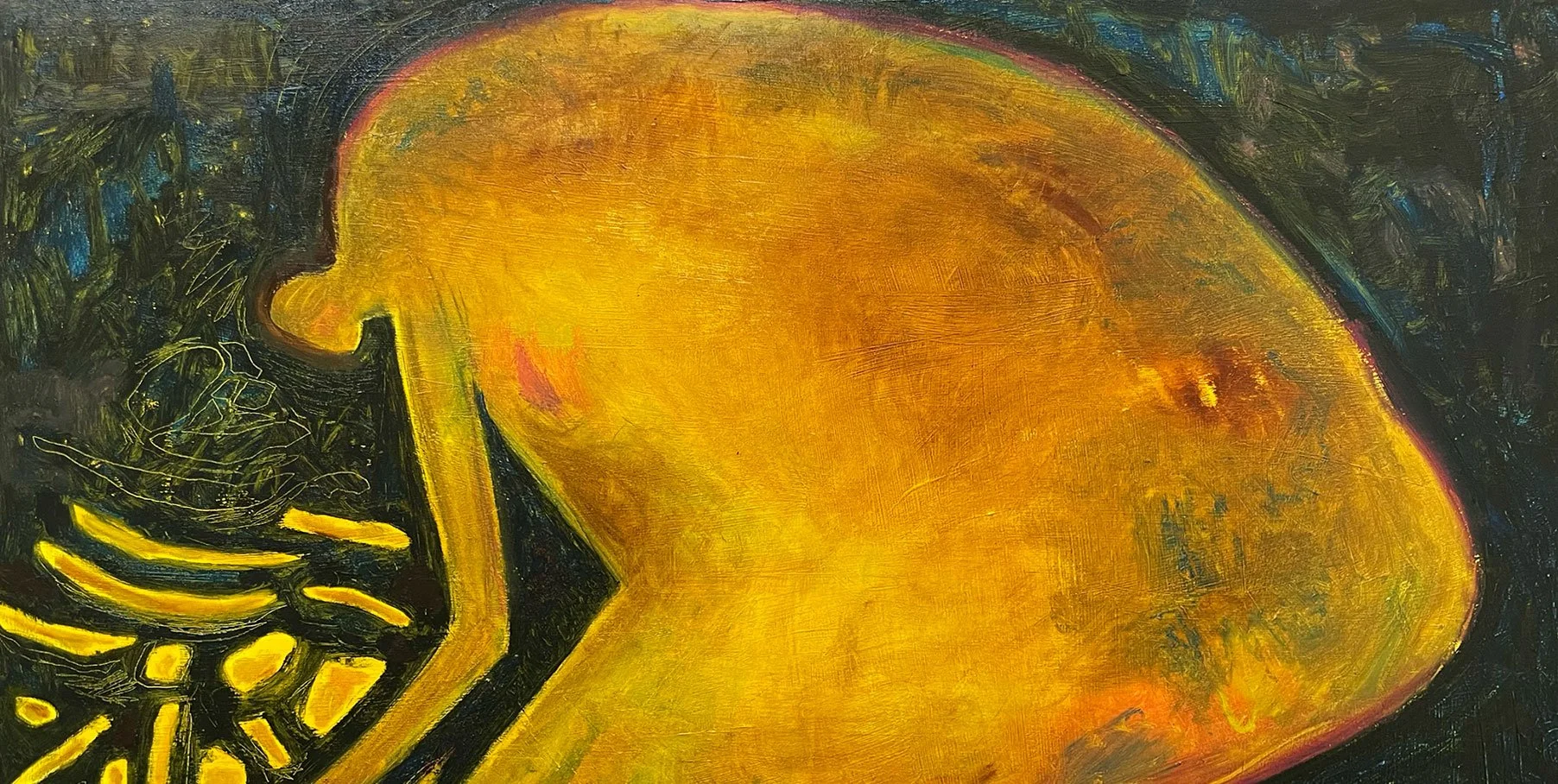
Praxis is now on view at the Cultural Arts Gallery on the IU Indianapolis campus. The opening reception is Friday, September 11, from 6–9 PM. I’m excited to share this new body of work and, perhaps more than anything, to see where the paintings have been leading me.
One of the things I noticed while making this collection was a glow developing naturally in the paintings.
I wasn’t consciously trying to create it. It emerged through the layering of the materials, the figures, and the spaces around them. Eventually, I began to understand the glow as part of the visual language of the work.
It feels connected to the sensation of higher thought: the moment when an idea is moving between people, when something is being discovered, understood, or passed along.
This also helped me understand a question I’ve been asked about the paintings:
Why abstract the human form? Why are the heads so small and the bodies so large and exaggerated?
I had to sit with that question for a while.
What keeps coming back to me is that I’m interested in telling the story of receiving knowledge not only through the brain, but through the body.
We tend to think of knowledge as something cerebral. Something that happens inside the head. But so much of what we learn is physical. We learn through practice. Through repetition. Through presence in a room with other people and participating in a shared process.
The body becomes a container for information.
Something older and more primal than our logical brains.
The exaggerated bodies in Praxis are a way of making that idea visible.
The Stewards
There are several recurring types of people you’ll encounter throughout the collection. The first are The Stewards. They have large, curved, often hunched bodies. Their forms are heavy and grounded, as though they are physically carrying the weight of what they have been entrusted with.
The Stewards are based in part on students I observed in the lab at IU Indianapolis. I watched them working with human remains, carefully cleaning and re-articulating them.
I began thinking of them as students of stewardship: students of humanity, of our Indiana history, and of the responsibility that comes with working with the remains of people who lived before us.
What I observed was a deep sense of care, respect, and practice. That became The Stewards.
The Scholars
Then there are The Scholars. The Scholars are talkative, collaborative, social, and full of energy. They are excited by a new discovery and eager to tell someone about it.
Their forms are more slender and pointed, with action lines, scribbles, and marks that move around them like speech and active thought. They are partly based on the archaeologists and researchers I’ve encountered through this work, but they are also a way of placing myself into conversations I have, so far, mostly observed from the outside.
I think about archaeological conventions, academic meetings, research discussions, and all of the rooms I imagine would be fascinating to enter. The Scholars are my way of entering those rooms through painting.
They are a little bit aspirational. A little bit imaginative. And perhaps a way of asking myself what it means to become a student of a field without having originally been trained within it.
Looking Beyond the Exhibition
I recently traveled to England, and I’m looking forward to sharing more about that experience in the coming months.
Praxis has opened doors into archaeology, conservation, restoration, craftsmanship, and the people who care for all of it. I’m curious to see where those doors lead next. For now, I’m looking forward to sharing the work in person and hearing how these characters are received.
What resonates?
Who feels familiar?
What feels strange?
And what stories do you see in them that I haven’t yet considered?…
